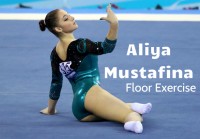
Russia will be the first major player to take to the floor hours from now, and they will very likely put on an unspectacular but solid performance. Their qualification score will probably be deceivingly low, as they will have to count performances from athletes who aren’t in the running for a spot in the team final, but if their most recent domestic competition and podium training videos reveal anything, they’ll manage to do what they’re capable of at present, not surprising anyone who’s been paying attention with surprise skills, but also not disappointing. They’ll be careful, as they usually are in qualifications.
Before moving on, I have a confession to make: I’m only a very recent convert to the relatively conservative type of gymnastics they exercise; the kind that plays it safe in the first half of the season, preserves athletes who could probably be competing if not for bigger goals somewhere in the future, and if pressed, prefers artistry over sheer power.
Case in point: I don’t think I would have enjoyed the floor routine Mustafina will attempt a few years ago, and I know there are some in the gymnternet community who will feel the same way now. In a gymnastics world that has seen FX tumbling skyrocket even since the 2012 Olympics, any opening pass less than an F value can be disappointing, or at least give the impression that you’re not watching a top floor worker. Even if you prefer Ross’s choreography to Skinner’s double twisting double layout, there’s something admittedly a bit boring about routines that lack massive tumbling; you’re left wanting just a little more.
If dance is not your thing, Mustafina’s routine will leave you wanting this week. Instead of simply replacing that triple twist with a double layout or some other fan fantasy (I don’t think I’ve ever seen her do a DLO on a standard mat), she has unveiled an entirely new way to conquer floor, completing only three tumbling passes and making up the lost value with an ambitious set of spins.
The new plan certainly doesn’t come out of nowhere. When Mustafina competed as a new junior, she was already favoring difficult turns, completing a Memmel and double turn in tuck stand, along with a simpler but all the more beautiful triple spin. Performing to Waltz on the Danube, Op. 314, she was exquisitely precise and polished, almost giving the impression of being a dancer’s gymnast.
After incorporating harder, senior-level tumbling, finding just the right balance has been the name of the game and her Achilles heel. The beginning of 2011 provided the most important lesson: going for a very ambitious tumbling set that kicked off with a 3.5 twist followed by a double Arabian, the reigning World Champion famously ran out of steam at the American Cup, losing the title to the up-and-coming Jordyn Weiber. And while barely bringing her third pass (2.5 to full twist) to her feet was the most obvious mistake, uncharacteristically sloppy dance was also indicative of a routine that was simply too much for the world champ’s endurance level. Fast forward to the 2011 European Championship qualifications, and she had ditched the losing strategy, mostly returning to her 2010 routine.
The 2012 routine was similar, though she mercifully replaced one of her twisting passes with a double tuck. Not even planning to compete floor exercise in the Olympic Team Final, Mustafina was put in the lineup after qualifications when she finished second among her teammates and qualified to the Floor Exercise Final. Proceeding to snatch the bronze medal in that Final, she may have confirmed the brewing conclusions of the team coaching staff: despite the poor twisting form and lower tumbling difficulty (at least compared with other floor finalists), their uneven bars star was still able to put together a winning floor routine; her artistry was not going unnoticed, and with exception of that triple twist, her execution was being highly rewarded.
It’s a good thing they realized that a somewhat non-standard routine could still deliver a big score, because with the introduction of the new Code of Points and its prohibition of standing in the corner before a tumbling run, not only Mustafina but the entire Russian team was going to require some creativity.
They say that necessity is the mother of all invention, and while I do believe that Mustafina’s current floor routine reflects her struggle to adapt to the new rule, I also suspect she would have kept four tumbling passes and simply run the risk of breathing deductions if not for her proven track record in dance.
And so we wait with baited breath. Though she began flirting with the triple Y turn at the 2013 Europeans and the Gomez (quadruple turn) at the 2013 World Championships, this will be the first time she privileges them, attempting both and at the expense of a fourth tumbling run. She has taken what she’s always done very well (the Memmel and the triple turn) and cranked them up a notch (really a few notches). Despite the lack of breathtaking tumbling, there’s nothing boring about this routine; it is, in fact, quite risky. If she can’t sense her inability to make it all the way around mid-spin and falls out of either her Triple Y or Gomez in the final rotation, it will not only mean a lower start value but she’ll also risk being deducted for an overrated Memmel or triple spin. Without a fourth tumbling pass, those deductions are crucial.
If she hits, on the other hand (and she showed herself capable at the last Russian Cup), we’ll be treated to a fresh take on floor, complete with another Mustafina-named element to celebrate. Even if you’re a bigger fan of tumbling, you have to admit that’s pretty cool.
No matter the outcome, just the fact that this routine is being attempted says a lot about the athlete attempting it. Despite being better known for her work on the uneven bars, the floor exercise has better reflected Mustafina over the years, mirroring the gymnast as she evolved from her seemingly effortless performances of 2010 to the not as effortless but arguably more mature performances of today.
Innovation is something we have always celebrated in gymnastics, as it not only distinguishes the sport from others but also allows individual gymnasts and programs to develop along their own strengths.
Mustafina has been a master at this, not unleashing anything completely out of this world but creatively appeasing the Code of Points at every turn. In the second half of her career, where “full strength” has become relative, she has done this with grace and with purpose, and it has allowed her to remain seriously competitive for longer than any of her closest rivals.
The balance of acrobatics and dance also reflects the person and team leader Mustafina has grown into, especially post-Olympics. For years, Mustafina’s coaches noted her predisposition to team success, and that attitude hasn’t changed even as team prospects have. Speaking with the press at the conclusion of the Russian Cup, personal coach Raisa Ganina confirmed her pupil’s leadership, stating: “Aliya is a team player. The team is everything to her. She takes everybody under her wing, looks after them, supports them. She does a great job in that department. It’s easy to compete with her.”
Finding the balance between collective and individual success, the inward focus needed for competition and the qualities necessary for team leadership is hard to teach, but Russia’s cornerstone seems to have found it whether it was with or without instruction. During the Russian Cup, I was delighted to witness the truth of Ganina’s words: All while delivering her own winning performances, Mustafina cared for her teammates (especially the younger ones) with ease: she chalked their bars, she braided their hair, she watched their routines attentively.
All of that is reflected her floor routine: innovation, grace, balance.
I’m not certain (in fact, I’m somewhat skeptical) that she’ll put it all together as planned, but I also don’t think fans should be overly concerned should that happen. Mustafina is too smart to repeat disasters (according to Ganina, she is a “gymnastics expert”) so she’ll find a way to make up for her losses.
If one thing is for certain, it’s her insistence on remaining part of the conversation for the fifth year in a row.
Udachi, Aliya! You are an amazing asset to this sport.
Aliya’s floor routines through the years:
Resource Quoted: https://www.youtube.com/watch?v=UCGy4pnuU-g
Translation: Lauren C
Article by Sara Dorrien
Photo cover: Brigid McCarthy