Isabel Iz recollects briefly the history of each modern era* Euros edition hosted by France. Do you see any trends?
.
France hosted the European Championships in 1992, in the city where Jules Verne was born: Nantes. 1992 is a very well remembered year in history as the world tried to adjust to the new political and geographical situation derived from the dissolution of the Soviet Union in late 1991.
In the sport world it was an Olympic year so there was no time for the newly independent countries to form their own Olympic committees, so for one last time the former soviet republics competed as one country, under the name of the Unified Team, at the Olympics in Barcelona. But for continental championships, like Europeans, athletes were now allowed to represent their own countries.
Svetlana Boginskaya was the defending (all around) European Champion at the time, she had won the title both in 1989 and in 1990; Nantes was supposed to be her third straight win and it almost was, until she fell on her last pass on floor. Boginskaya bounced back by winning the beam title, therefore giving independent Belarus its first gold medal.
The new all-around champion was Tatiana Gutsu who later that year would crown herself Olympic all-around champion. Tatiana was representing her native Ukraine, which she made very proud by winning medals on all the events: gold on the AA, VT and UB, silver on the BB, and bronze on the FX. Future Olympic beam champion Tatiana Lyssenko was also representing Ukraine and she won a silver on the uneven bars; the third medalist for Ukraine was Ludmilla Stoybatcheva who won bronze on beam. Unlike her teammates, the Tatianas, Ludmilla did not make the Olympic team for Barcelona. Ukraine was the most successful team at the championships with 7 medals out of 15 possible.
Romania’s top medalist in Nantes was only 14 and a half and her name was Gina Gogean. She took the title on floor and was the silver medalist on the all-around and vault. Vanda Hadarean added another medal for Romania with her bronze in the all-around.
Despite the Ukrainian and Romanian domination of the competition a local girl managed to sneak into the medals, her name: Melanie Légros. With a 9.900 she gifted the home audience a silver on the floor exercise.
—————————————————————————————————————————
Eight years later, in 2000, Europeans arrived again in France, this time in the capital: Paris. This Europeans were heavily dominated by Russia. Led by Svetlana Khorkina, Russia took the team title and Khorkina crowned herself all-around, bars and beam champion. Yelena Zamolodchikova, who was only 17 at the time, took two silvers (AA, VT) and one bronze (BB). Russia’s dominance was rounded up by Yelena Produnova who took a silver on floor and a bronze on the uneven bars.
Out of 19 medals awarded, 9 were won by Russia.
At the time Ukraine was still a strong team. They took the team silver, and their star Viktoria Karpenko won three medals: silver on bars and floor, and a bronze in the all-around.
Romania was lead by the veteran Simona Amanar to a team bronze; individually Amanar took the vault title and a silver on the balance beam. Andreea Raducan, then the current world champion on floor, took silver on floor behind a local girl that managed to give pride to her home country by becoming floor European champion: Ludivine Furnon. At those championships three gymnasts tied for silver on floor: Raducan, Karpenko and Produnova with a 9.812 against Furnon’s 9.875.
All of the individual medalists in Paris went on to participate at the Olympics in Sydney later that year and Khorkina who was the current European champion on bars turned her title into a Olympic one in Sydney.
—————————————————————————————————————————–
Once again, 8 years later, Europeans arrived in France, this time in Clermont-Ferrand. By 2008 many things had changed in gymnastics. The three main changes were that: Europeans would either hold an all-around competition or a team competition but not both in the same year, also the two per country had been around for a few years while the new scoring format that had made the perfect 10 disappear, was only two and a half years old.
Europeans started with drama for the home-team, during floor warm ups in the qualification round, Isabelle Severino, who was just days away from her 28th birthday, suffered a double injury that included a torn Achilles. Despite the sudden loss of Severino, who in the previous round had contributed the second highest beam score for her team, France managed to qualify in fourth place to the team final.
During the team final Romania won over Russia, but the fight for the bronze medal was the one for which the home-audience was holding its breath. With only four gymnasts competing in the final, France managed a historic third place finish, ahead of Italy. Their win remains the only team medal France has ever won at Europeans.
The twelve remaining individual medals were distributed among six different countries. Oksana Chusovitina won gold on vault for Germany while Italy took both silver and bronze with Carlotta Giovannini and Francesca Benolli, respectively. Beth Tweddle, who had just turned 23, took silver on floor for Great Britain. Ukraine won two medals with Alina Kozich’s silver on beam and Dariya Zgoba’s bronze on bars. Russia won only two medals, but they were gold medals handed by Ksenia Semenova who took the titles on bars and beam. And Romania was the most successful country with a bronze on floor from Ana Maria Tamarjan, a silver on bars from Steliana Nistor, and two medals from Sandra Izbasa a silver on beam and gold in the floor exercise.
All of the individual medalists in Clermont-Ferrand went on to participate at the Olympics in Beijing later that year and Sandra Izbasa who was the current European champion on floor turned her title into a Olympic one in Beijing.
————————————————————————————————————————–
So here we are 7 years from that day and this year’s European Championships are set to take place in Montpellier, and quite a few gymnasts that were present in Clermont-Ferrand are set to participate.
Anna Pavlova, a two time Russian Olympian, who finished fifth in the vault final in Clermont- Ferrand will be Montpellier representing a different country, Azerbeijan. She’s also the current silver medalist on vault. Anna is 27 years old.
Vanessa Ferrari, also a two time Olympian and former World all-around champion, who finished fifth on the beam final in Clermont-Ferrand, is scheduled to be present in Montpellier. And she enters as the current European Champion on floor. Vanessa is 24 years old.
Rebecca Downie contributed with her team’s top scores on vault and beam during the team final in Clermont-Ferrand. Today she enters the European Championships in Montpellier as the current European champion on bars. Rebecca is 23 years old.
Ksenia Afanasyeva competed on vault and floor during the team final in Clermont-Ferrand. Since then she has come a long way that includes two Olympics, a World and European title on the floor exercise. Ksenia is also 23 years old.
.
*The article does not include the first Euros edition hosted by France, Paris 1963. You can find a summary of the competition here.
.
Article by: Isabel Iz
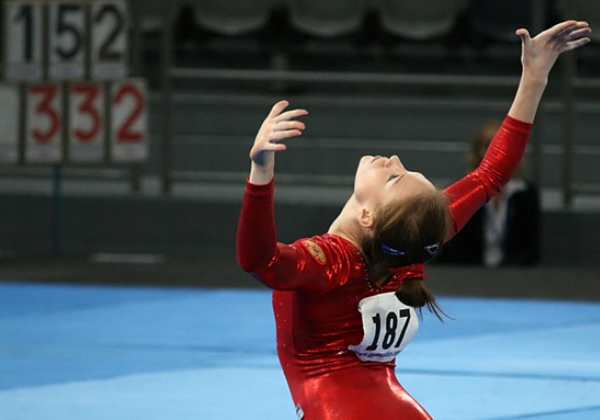
Photo cover: Ksenia Afanasyeva, by Nadia Boyce (from 2010)