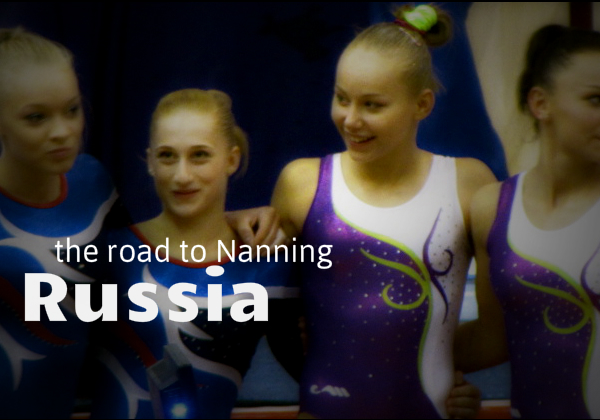
With the conclusion of the Russian Cup last Sunday, Andrei and Valentina Rodionenko didn’t miss a beat announcing the provisional team for the 2014 World Championships: Maria Kharenkova, Ekaterina Kramarenko, Aliya Mustafina, Maria Paseka, Alla Sosnitskaya, and Daria Spiridonova.
Without belaboring the point, I will simply state that this is not the team most of us imagined as the competition proceeded last week, nor is it the one I would have chosen. Ultimately, I believe Russia’s highest scoring potential puts Paseka, Mustafina, and Sosnitskaya on vault; Mustafina, Komova, and Spiridonova on bars; Mustafina, Kharenkova, and Spiridonova on beam; and Mustafina, Paseka, and Sosnitskaya on floor exercise.
Needless to say, the federation didn’t ask for my opinion, and despite the disappointment that they won’t be putting their strongest foot forward, I do understand why they named the team they did.
The most obvious question mark in the preliminary line-up comes in the form of 2008 Olympian Ekaterina Kramarenko, mostly because unlike the rest of the group, she is the only one not to have medaled in an Event Final last week. I watched her with a mixture of admiration and mirrored frustration in Penza, impressed by how well she kept apace with younger teammates, especially after an early season hampered by illness, but saddened by her inability to deliver the cleaner routines needed to make her placement on the team a given. Kramarenko allegedly never stopped training following the Bejing Olympics, returning to the National Team roster in 2013, and since then she has missed out on two opportunities to compete at major competitions after being named to the team: the first was the University Games after the recently hospital-confined Aliya Mustafina joined the effort in Kazan at the last-minute, and the second was the European Championships in Sofia, when Kramarenko’s own hospitalization put her return on hold.
Needless to say, she has certainly had her share of bitter disappointments and unfortunate timing since returning to competitive gymnastics, and while she appears to be on the cusp of turning another page, she didn’t manage to make that impression very loudly in Penza. Her floor routine is case-in-point: opening with a DLO and usually completing a triple twist for her second pass, it was one of the more dynamic performances on display, but she struggled all week with execution to her visible dismay, most notably during the Event Final. This was especially disappointing because Kramarenko used to be a floor specialist, and eyeing Russia’s current deficit on floor, she undoubtedly imagined herself as part of the solution. I still think it could happen, but probably not in time for Nanning.
Floor flounders and lack of podium-finishes aside, however, Kramarenko delivered consistent routines on balance beam and uneven bars, placing third, fourth, or fifth on each over four days of competition.
To me, it seems that the Kramarenko selection betrays a bit of anxiety among the federation. It’s a rather conservative approach, choosing to take someone who probably won’t deliver the highest scores but who can fill in virtually anywhere she might be needed. It’s also worth noting that while Komova came through with a bold and accurate performance during the Event Final, she struggled with her bar set earlier in the week. Kramarenko, by comparison, never pushed past 15 but she delivered consistently. She even placed ahead of Komova in the Team Final.
Bottom line, it seems that the coaching staff is wearier of competition meltdowns and too few options once they get to China more than they are of not squeezing out every tenth they can muster. The conclusion is reflective of a program that has suffered many side-lining injuries and hasn’t produced any new international-level all-rounders in the current Olympic cycle. They simply aren’t willing to buy a plane ticket for someone who can’t contribute to more than one event. (It’s worth noting that while there’s a fair chance Maria Kharenkova will only perform on balance beam in the Team Final, she proved her proficiency on other events, thereby shedding her own “event specialist” handicap. If someone is suddenly unable to compete her event once in Nanning, Kharenkova gets plugged in.)
All of that being said, it’s necessary to emphasize that we’ve been given a “provisional” team only, and it’s very possible that Viktoria Komova will put together a winning combination within the next few weeks, upsetting the current line-up. (She would probably replace Daria Spiridonova or good friend Kramarenko.)
In an interview given to ITAR-TASS, Valentina Rodioneno mentioned that Tatiana Nabeiva and Anna Rodionova were also not to be counted out yet, though their inclusion would surprise me. Tatiana Nabieva gave strong performances on uneven bars and especially on vault this week, but she would muddy up the team puzzle pretty severely without a floor routine ready to go, and Anna, for her part, gave underwhelming performances in Penza, no doubt still struggling to regain her prior form after a surprising and intense preparation for world’s last year.
Regardless of which team makes the trip to Nanning, I’m guardedly optimistic about their chances for medaling. Vault and Floor Exercise will be comparatively weak, though in contrast to the past it’s the latter that’s more concerning: with lower start values, they will need to perform their routines much more cleanly and consistently than they did at the Russian Cup.
On bars, they have good reason to believe they’ll deliver very well, especially with likely upgrades from Mustafina; and on beam, their D scores are comparable to other teams. Aiming for very high execution scores on both pieces will be important in the shadow of vault and floor, and that’s very doable.
Ultimately, I do not think they will be in the hunt for a team title, but I do think they will exert more pressure on their rivals than generally presumed. There’s no massive chasm between Russia and all of the other teams (who are also in rebuilding mode), so game-day will count. If Russia does all that they’re capable of, they will be part of making it an interesting competition.
The effort will be led again by Aliya Mustafina, who will most likely be called on to perform all four pieces. She entered the Russian Cup simply “for practice” and had “no intention of medaling,” according to an interview given to Penza Pravda.
After watching her in practice and in competition all week, it’s impossible to take that comment seriously, as she sailed quite easily to all-around gold and delivered very competent performances everywhere else. It seems that she’s measuring her fitness by her own past performances along with the intensive training she’s accustomed to having before a competition, rather than by taking a hard look at those who will be vying for the same medals. It’s probably just as well, because in the absence of teammates who can consistently push her and exert some pressure (especially all-around), a psychological system that relies entirely on personal standards and internal rewards is necessary to remain competitive on the world stage.
However, even though the team’s leader is on a level all her own, Russia’s top group is much plumper this year than last. If last year was considered a kind of lull in the shadow of post-Olympic drama and injuries to the A-teamers, this year the coaches must seriously be considering the possibility that some of those veterans might not make it back; hence, those born after 1996 need to be invested in. So far, this quad does not boast a superstar Mustafina-Komova duo with a Grishina-Afanasyeva duo right behind them, but youngsters like Kharenkova and Spiridonova are talented team players; they have shown themselves quite capable of delivering world-level routines on their best pieces.
In conclusion, the team has undergone quite a celebratory improvement over the past year, and even if they come up short, I do not foresee them making the same mistakes they did in Sofia. Nanning will be a big change from Penza, but no rookies are making the trip this time; they’ve all competed at major international competitions, three of them at the Olympics. (And the possible replacements will boast the same resume.)
Putting aside the frantic predictions and rushed comparisons to the USA for just a moment, it’s worth picturing the snapshot taken on the last day of the Russian Cup and comparing it to the one taken in 2013, especially after huge breaks such as Grishina’s knee injury and Komova’s and Afanasyeva’s prolonged returns.
Judged by the team’s own merit, things really are OK.
Article and photo by Sara Dorrien