Sara, I couldn’t agree more regarding the surprises. I usually don’t like them in real-life but in gymnastics they just make a competition a whole lot better, and memorable, isn’t it?
Although the overall level of difficulty was lower, especially affected by the absence of the continent’s top two all arounders, this was still an entertaining event and one that will go down in the history books as one of the more pleasant Individual Euros.
It will be interesting where team Great Britain will go from here: the Downies are fierce competitors (both of them!) as well as very gifted athletes, Claudia Fragapane just finished her 4th major international competition and although she had mistakes she has not disappointed (and now is a floor medalist too!) while Amy Tinkler although not as visible at this competition, gained a lot of experience. Plus, she can help on floor and vault, events that were still not great last year for the team.
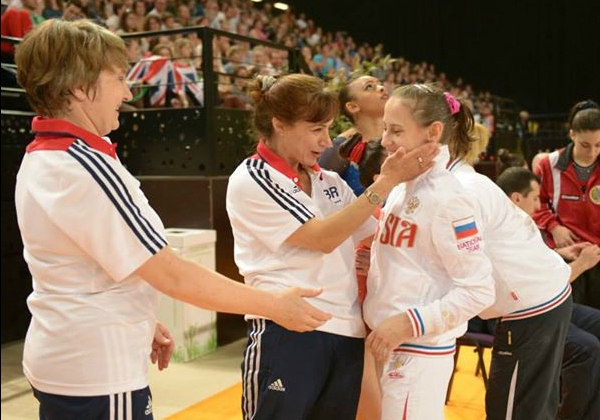
Russia seems to have hit the sweet spot with 4 individuals with such different strengths that were paced beautifully for these Championships (unlike the disaster they had to deal with in 2014, which also led to a 3rd place finish in the team competition). Unfortunately they didn’t escape the curse of the untimely injuries.
Italy was really unlucky this year both because of illnesses and injuries and with draws / qualifications results. But Fasana has developed really nicely and is starting to blossom this year; she may have not medaled but she was not unnoticed. The consistency of the other three Italian all arounders (which scored within 0.2 of each other) shows that this team has depth despite some heath scares (Vanessa Ferrari, Enus Mariani).
Romania is at a crossroads. Andeea Munteanu’s BB win was a victory of the school of gymnastics but not indicative of the future of her team. It felt like ghost of the Deva school of balance beam pushed through. Ukraine’s Jana Demyanchuk also won a gold on balance beam in 2009, remember? What I mean is that Romania has a lot of work ahead if they want to keep up. It was not a terrible performance after all (Jurca’s and Bulimar’s consistency during the AA not all is lost) but some strategic enhancements are in order if they want to be on the podium again. Larisa Iordache will give a huge boost when she returns. But younger gymnasts deserve to go into the next competitions equipped with the tools that would give them a fair chance in the fight for event finals finals. Waiting for the next astonishing talent, a next Iordache or Izbasa or Ponor will not be enough, sadly.
So, given the fact that many federations saw the European Championships and the European Games as separate objectives with the intention of posting different teams, it was a pretty great overall competition. Germany for instance had a young inexperienced team at Euros and their results were not spectacular (only a beam final); the federation just announced a team of more experienced athletes at for the June competition in Baku.
I would go as far as to say that with the exception of the splat-fest of a BB final, the finals at Montpellier Euros were good to great on a scale of watchability. It’s a pleasure when there is some serious competition for the first place, with two or more gymnasts equal in their abilities of execution or at least in difficulty scores, and when the outcome is tough to predict. When the winner has to do a great routine or to show some spectacular gymnastics to win, we basically reconnect with our motivation to follow this sport.
The teams for the European Games are already starting to be announced. For the gymnasts, the next big competition is approaching rapidly; and for us too, it’s time to move on.
Article: Bea Gheorghisor
Photo cover via UEG on Facebook
Follow us on Facebook and Twitter!