Great choices for the “unsung talents”, Sara. I was absolutely delighted watching those routines. I especially felt fortunate for the fact that it was a fantastic meet, with almost all the teams and individuals showcasing their best. These Dutch are doing a great job changing the perception we have of beautiful gymnastics with lower difficulty. In today’s code (at least) these routines were quite well received and even though they didn’t win many medals, the Dutch performances were appreciated positively by the judges.
I also can’t stop thinking about the qualifying round and how so many teams managed their best performances at worlds in ages. Some qualified to the TF (and to Rio), others didn’t, although their performances were very deserving. I am thinking here, besides 9th place Brazil, knocked out of the final by just a couple of tenths (in a dramatic last vault by the Netherlands), but also of France. The routine that illustrates the best the team’s performance was Marine Brevet’s superb floor:
https://www.youtube.com/watch?v=lul1Mx6al6M
So, besides the previously-mentioned conclusions of the articles leading up, in order to get a fuller picture of the event, we also need to highlight the following:
Glasgow will be remembered as the moment Great Britain entered the Big 4.
They didn’t really emerge out of nowhere (Beth Tweddle is a multiple world champion) but the bronze in Glasgow was GB’s first ever team medal at worlds. Their European ascent has been going on for at least the past 5 years. In Birmingham (2010) they placed 2nd behind Russia. In 2012 they qualified 3rd (behind Russia and Romania) but they ended up 4th in the final behind Italy (with Romania and Russia winning gold and silver respectively). Two years later they “won” the qualifying round and then were defeated by Romania in the team final, with Russia ending up 3rd. And since 2013 their junior team has been even more successful, constantly challenging Russia for the supremacy on an European level.
In Glasgow, team GB appeared with a well balanced mix of veterans (B Downie, Ruby Harrold), core members of the 2014 winning teams (Fragapane, K Simm) and new seniors with a wealth of Junior international experience (Ellie Downie, Amy Tinkler). The uneven bars had been their strong event for years and in Glasgow they capitalized on that, presenting 3 amazing bars routines and 2 other decent, dynamic routines. But during the team final, the difference compared to 4th place Russia was made on floor. Great Britain have improved a lot on this event in just 2-3 years and this is where the new members of the senior team counted the most (Tinkler, Downie, Fragapane, added in 2015 and 2015 respectively).
They competed under a lot of pressure (see Harrold’s tears after finishing her team final routine on bars and the Downie sisters’ mistakes on the same event). It was nerve-wracking and imperfect, but there were also moments of brilliance. The team medal completed the picture naturally. It was a reward after years of systematic investments in gymnasts and technicians, of generations of gymnasts and coaches that brought the program one step closer. This was the moment when it all came together: from uncontrollable factors like the mistake of others, to depth, strong routines, the ability to perform when it counts.
For the members of the US team it was largely an internal affair. By this I don’t mean that they were so dominant that we could not even notice other teams. But they did a pretty good job getting their fair share of accolades: nine spots to finals, eight medals, five of them gold, two silver and two bronze medals.
Their qualifying round was a beautiful and nerve-wracking competition within competition. I don’t think that their placement as a team was questioned for a second, nor the fact that they would qualify gymnasts (at least one) to each final. Prelims was the only time when each gymnast was out there for herself and by the number of smaller or larger errors, it seems that this affected some of them psychologically. Perhaps when they compete as a team they are so confident partly because they know that the chances anyone challenging them (event remotely), are very slim. While when the competitions levels up, their mental game might not be as strong. (That, or the fact that they might have been slightly over-worked after what seemed like a never ending camp prior to the competition, as mentioned by Simone in an interview after qualifications).
The only one unaffected by this was Simone herself. And I say this despite her mistakes during the AA event. I don’t think that she felt pressure not to make the tiniest adjustment. Mind you, putting her hand down on the beam was not her first major error at Worlds (remember the bars routine from 2014 qualifications). I don’t rule out that she could feel a sort of pressure knowing that she is right now, as we speak, making history (or has already entered the world records book with her 10 gold medals at worlds). But really when she is competing during an all around world final, I doubt that she has the time to think about “what it all means”.
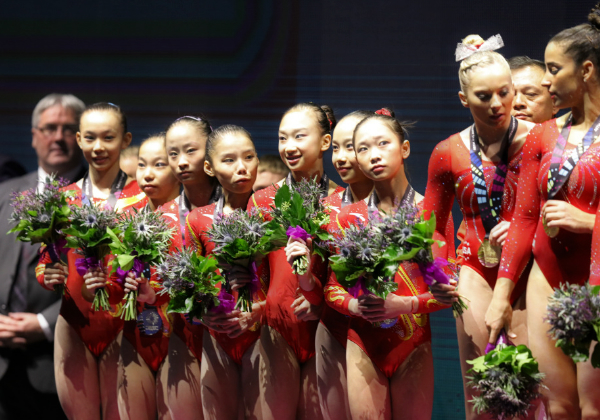
China seems to still be searching for the best team. They had a very uneven performance from day to day. They were all over the place on their favorite events in qualifications, but they killed it on vault and floor. I feel like there was a lot of shuffling this past quad in finding the best formula for the team, and things are still being attempted. Only two three members of the 2014 squad also competed in Nanning in 2014 (Tan Jiaxin, Chen Siyi and Shang Chunsong). Chunsong was the only member of the team to make it to all three World championships of the quad. But as the team was categorically stronger than in 2014, it seems that these changes are working out. They topped their 2014 scores on three out of four events, delivering almost a two point improvement on floor but also improving significantly their 2014 vault and bars totals. If they want to maintain their silver medal chances for Rio, they will be even stronger with a team built around Shang Chunsong (4th in the AA and bars and floor event finalist) and Yao Jinnan (2012 Olympian, multiple world medalist and a UB world champion). Yao has been out this year due to a shoulder injury and hopefully the time away and the rest will benefit her. But Wang Yan (vault and beam finalist in Glasgow) will also have to be around, she showed so much potential with her difficult vaulting and great beam and floor difficulty (and execution when hit).
Will Russia learn? I feel like a lot has been said about Russia during Glasgow Worlds. They were again brilliant, inconsistent and eternal elegance prize winners, even when they fell. Afanasyeva did a great job as team captain. But despite their brilliance and beauty and interesting routines, they still needed someone that could stay on the beam when it counted. Mustafina was missed the most during that team final beam rotation.
But let’s not forget their best day, which was the qualifying round: they didn’t count a fall and they “won” uneven bars and came second after the US on vault and beam, qualifying for the team final in 2nd place. Even then, the fact that Spiridonova’s 13.1 on beam had to count towards the total (they posted only 4 routines on this event, choosing not to discard a score) combined with the 11th total score on floor, showed sever lacks; you could see exactly what the weak spots were. And unfortunately these weaknesses increased in a team-final scenario and the team dropped from 2nd to 4th. For Rio, Russia will have to either bring Mustafina back or to drastically up their floor and beam game, or even better, do both.
Agree or disagree, tell us your opinion. What impressions were you left with at the end of the Glasgow Worlds?
Article: Bea Gheorghisor
Photo: Myriam Cawston